

Can my mindset affect how successful my business becomes?
When we talk about mindset we don’t mean simply positive thinking. Instead, ask yourself: ‘can my mindset impact my business?’ Are you in a fixed or a growth mindset most of the time? We may immediately say we have a growth mindset, but if you stopped and thought long and hard about the last few months, have you been exhibiting a growth mindset focusing on change, improvement and progression or fallen into the thought process of ‘this is how things are’ i.e. a fixed mindset?
Perhaps consider how you’ve reacted and felt when the business puts pressure on you. When a decision feels risky, or when the numbers are not saying what you hoped, it is easy to slip from “I am willing to learn” into “this is just how it is”.
Stanford describes a growth mindset as reframing perceived failures as opportunities to learn and grow. In business ownership, we would put it more bluntly: can you look at what is not working without immediately defending the way you have always done it? This shift is really powerful to enable you to reach your potential as a business owner and achieve great real-world performance!
A quick summary
Mindset affects business success because it influences how honestly you look at problems, how willing you are to learn, and how quickly you change behaviour when the evidence asks you to. Many owners believe they are growth-minded, but fixed thinking often appears around delegation, pricing, accountability, profit, team performance and the owner’s own role. It is a habit that holds owners and businesses back, and we’d challenge you to find ways to overcome it.
The stories that keep owners stuck
You can spot a fixed mindset in your business if you hear yourself saying ‘I have already tried that’ to close down an idea or challenge, that the team are not ready, that customers will not pay more, or that you have to stay close to a particular area because no one else will do it properly.
Sometimes those statements are true, but is there really no possibility for them to change? This thinking can keep a business stuck for years because it gives the owner just enough comfort to avoid testing a different approach or themselves.
A better habit is to slow the thought down. What do you actually know? What have you assumed? What would happen if you tested it properly instead of deciding in advance?
That is where the mindset becomes a tool for growth. It affects pricing, sales, leadership and cash.
The E-Myth problem: still thinking like the technician
The E-Myth idea is useful because it explains a pattern many SME owners recognise as their business grows. The owner often starts as the person who is good at the work, only to discover that running the business requires a different set of skills and expertise to fulfil many other roles the business requires. The E-Myth describes the Technician, Manager, and Entrepreneur as three distinct business personalities, with the Technician focused on doing the work and the Entrepreneur focused on creating a business that can operate without constant owner involvement.
This is where mindset often gets exposed. The technician part of the owner wants to sort it, fix it and keep it close. The business owner has to ask a different question: why does this keep needing me?
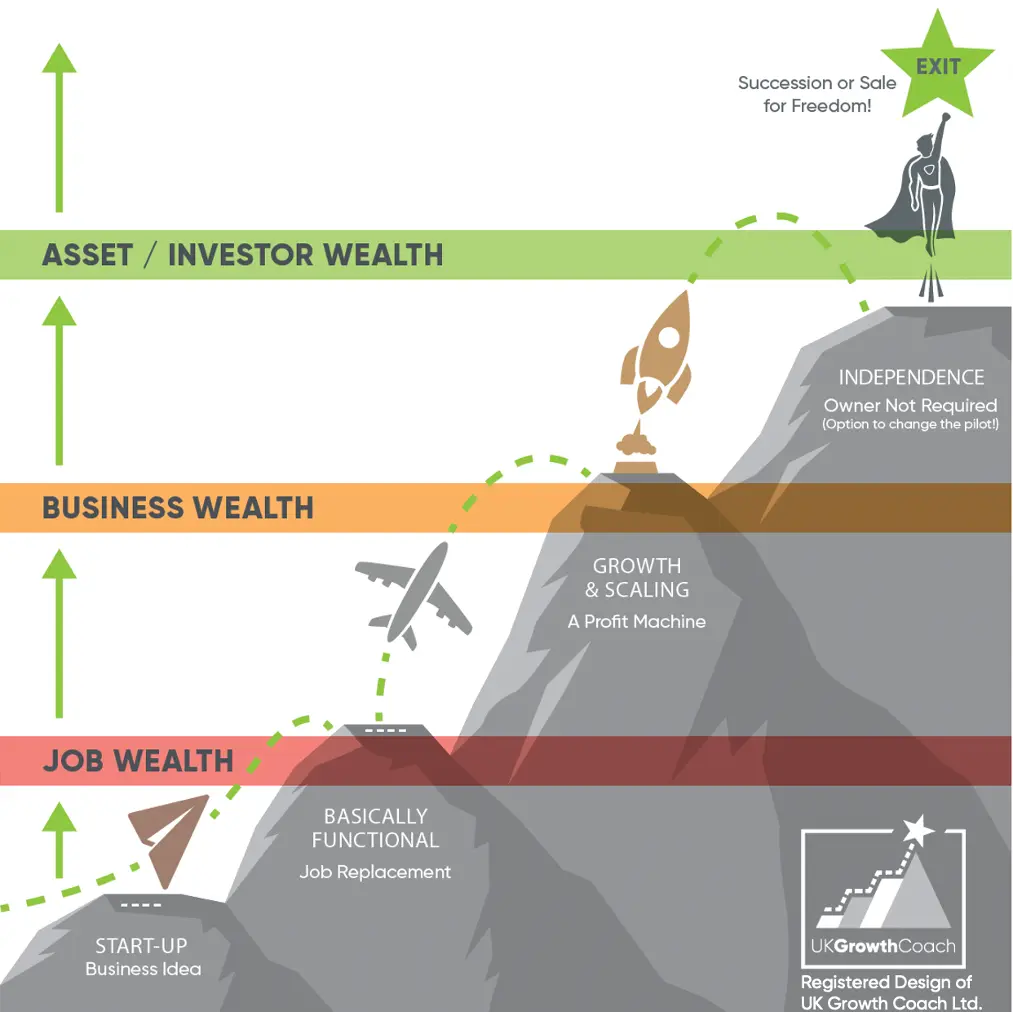
Mindset on the Progress Mountain
At UK Growth Coach, we developed a model called the Progress Mountain to help business owners understand where they are on the ownership journey and what the next stage asks of them. The model identifies where the business is now and the steps needed to reach the next level.
At Job Wealth, the owner often thinks, “I earn because I work.” At Business Wealth, the questions become, “What makes it stronger over time? What needs to be systemised, measured or delegated?” When you start thinking about the business as an asset, the questions change again. “How does the business create value without everything depending on me?”
How to shift mindset into behaviour
The best place to start is to identify one recurring issue: weak margins, poor delegation, inconsistent sales, slow decisions, cash pressure or a team member who never quite steps up.
Then ask yourself what you are assuming, what evidence you have, what you may be avoiding, and what you would do differently if you believed improvement was possible.
After that, choose one visible behaviour. For example, review a number monthly, create a clearer handover, let someone make a decision without taking it back, test a price increase carefully or have the conversation you keep postponing.
Mindset only matters if it changes what you do.
Why accountability helps
Most owners do not need more theory. They need a rhythm that stops them slipping back into the old explanation when work gets busy.
If you want to explore whether your mindset is helping or limiting your business success, start with a proper conversation.

FAQs
Can mindset affect business success?
Yes. Mindset affects how you respond to pressure, feedback, risk, people issues and change. If you keep explaining problems away instead of testing a different approach, the business can stay stuck for longer than it needs to.
What is a growth mindset in business?
A growth mindset in business means being willing to learn from evidence, mistakes and feedback. It is not just about being positive. It is about changing behaviour when the facts show that something is not working.
What is a fixed mindset in business?
A fixed mindset treats current limits as permanent. In business, it often sounds like “my team cannot do that”, “our market will not accept it” or “this is just how things work here”.
How do I know if I have a fixed mindset as a business owner?
Look at the problems that keep returning. If your explanation always protects your current habits or puts the issue entirely outside your control, there may be fixed thinking involved.
Why do business owners resist change?
Change can feel risky because the owner’s current habits are often the same habits that built the business and made it achieve what you have to date. Letting go of those habits can feel uncomfortable and risky, even when the business has outgrown them. Building capability and confidence in the knowledge of how and what to change does require new thinking, new ideas and possibly education for the owner.
How do I develop a growth mindset as a business owner?
Start by choosing one recurring issue and looking at the evidence. Ask what is happening, what you are assuming, what the consequence is if it continues, and what one practical change would test a better way forward.
Can business coaching help with mindset?
Yes, when it stays practical. Coaching helps owners test assumptions, spot patterns, make decisions and stay accountable while new behaviours become normal. A key part of our coaching is to reflect back, summarise and paraphrase, in order to put back in front of owners the sometimes contradictory stories they tell themselves or the self-imposed barriers they have created.
What does The E-Myth say about business owners?
The E-Myth book explains that owners can spend too much time as the Technician, doing the work, rather than building the systems, people, and direction needed for the business to run without constant owner involvement.
How does mindset affect business growth?
Mindset can hold owners back from change, meaning they opt for tolerating poor performance, bad results and higher stress levels than taking responsibility and doing something different. Mindset can affect everything from whether you delegate, price properly, review numbers, challenge poor performance and make time for leadership work. Those choices directly affect growth, profit and owner freedom.
What is the first step to changing my business mindset?
Pick one issue you keep explaining away. Write down the underlying assumption, check the evidence, and choose one action to test a different approach.