

TLDR
If your business depends on you for everything, working harder will only take you so far. To change this situation, start by identifying all the roles within your business, which ones you are responsible for and how long each of them should take. Just because you can do something, doesn’t mean you ought to be, so clarify who should do what, and develop your team including delegate effectively, so you can give the work of business ownership the attention it deserves. This approach will increase capacity, enable your business to progress and ultimately generate better results.
Introduction
Do you ever reach the end of a particularly busy week, look back at everything you’ve achieved, and wonder why your business doesn’t seem to have moved forward?
You’ve dealt with customer enquiries, managed the team, resolved operational problems, checked the finances, completed a few quotations, and perhaps even squeezed in some marketing.
You’ve been busy…extremely busy, in fact!
Yet that strategic project you’ve been meaning to start remains untouched, the recruitment plan hasn’t progressed, and you’re still the person everyone comes to whenever something needs a decision.
Sound familiar?
For many SME business owners, this is an uncomfortable reality.
They’ve successfully developed a business that provides employment, serves customers, and generates turnover, but somewhere along the journey they’ve also become its most heavily relied-upon employee.
So, why does this happen, and more importantly, what can you do to change it?
You’re doing more jobs than you realise
When we ask business owners what their role is within their company, the most common answer is something along the lines of Director, Owner, Founder, or CEO.
That’s their title, certainly, but is it an accurate description of the range of responsibilities they really have?
In most smaller businesses, there are considerably more roles to fulfil than there are people available to fulfil them.
If you think about a company employing six people, it will need someone with responsibility for:
- Business direction setting and strategic planning.
- Marketing and lead generation.
- Sales activity and client conversion.
- Operational delivery and quality control.
- Financial management and credit control.
- Human resources and team development.
- Customer service and account management.
- Systems, processes, and administration.
These are all distinct business functions, each containing its own responsibilities and regular activities, and that’s without separating each area into leadership, management and front line tasks!
Yet the company only has six people.
Consequently, individuals take on multiple roles, and the business owner, more often than not, will be carrying a disproportionately large number of them.
In reality, whilst you may be running just one company, you are personally probably undertaking eight or ten different part-time jobs within it.
That creates an interesting problem.
Wearing multiple hats isn’t necessarily the issue
Let’s be practical for a moment.
Few SME businesses can afford to employ a full-time Marketing Director, Finance Director, HR Manager, and Operations Director.
Nor would they necessarily want to.
If your business only requires four hours of financial management each week, employing somebody for 40 hours would make no sense.
Having people fulfil several different roles can be perfectly appropriate, particularly during the earlier stages of business development.
The difficulty emerges when these responsibilities haven’t been properly defined, their time requirements haven’t been considered, and nobody has established whether the individuals holding them have sufficient capacity or capability to perform them effectively.
Imagine employing somebody as your Sales Manager and subsequently informing them that they’re also responsible for marketing, HR, financial control, customer complaints, and overseeing operational delivery.
You’d probably anticipate a few challenges!
Yet this is precisely what many business owners expect of themselves.
As nobody has formally recognised these additional roles, there’s often little consideration given to how much time each one deserves, whether the owner is suitably skilled, or whether somebody else might be better placed to undertake it.
In our experience, most owners are highly skilled in one or two areas (normally those they were trained in when employed by someone else) and largely learning through trial and error for the rest.
Which means making quite a few unintentional mistakes, a lot of rework, or having to do a lot more work for the same result as could be achieved by someone with the skills and experience of that aspect.
Try looking at your organisational chart differently
One of the exercises we undertake with business owners at UK Growth Coach involves developing an organisational chart based on the roles their business requires, rather than simply the people it employs.
The distinction is important.
A conventional organisational chart might show the Managing Director at the top, three managers beneath them, and several employees reporting into those positions.
Our alternative approach begins by identifying the individual functions and responsibilities needed for the company to operate effectively.
We then allocate names to those positions.
The resulting picture can be quite revealing.
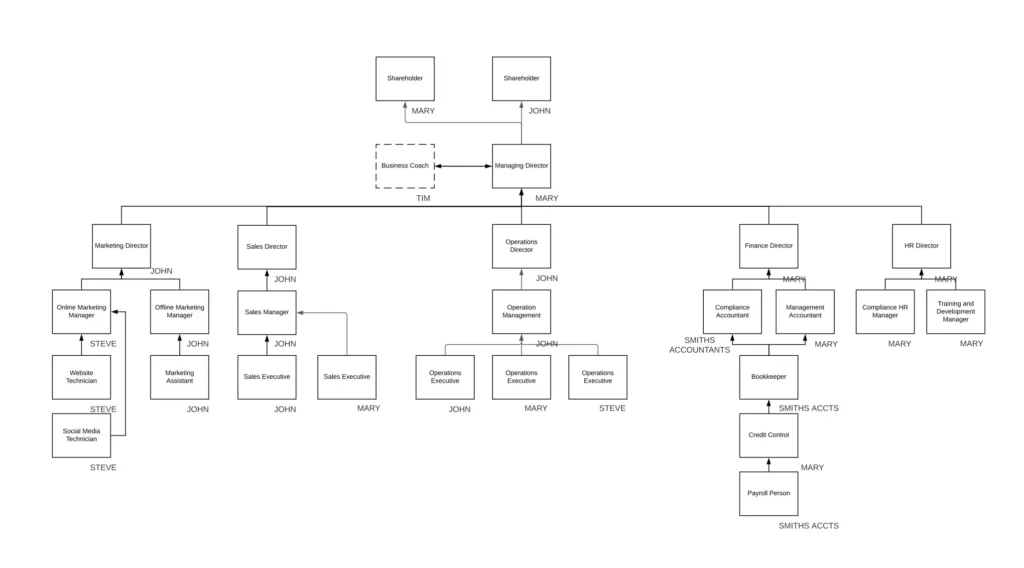
In your own version of this, you might discover that your name appears in nine separate boxes, your Operations Manager’s in four, and your administrator’s in another three.
Suddenly, what previously appeared to be a relatively simple business structure looks rather different!
It also raises some valuable questions:
- Which roles genuinely need to be performed by you?
- How much time does each role require to be performed properly?
- Which responsibilities are currently being neglected or are under-skilled?
- Who else could undertake some of these activities?
- Where would additional resource create the greatest business benefit?
Importantly, having nine roles doesn’t automatically mean you need nine employees.
It simply means you should recognise that nine distinct areas of responsibility exist and make informed decisions about how they’re fulfilled.
It also often means recognising that your training shouldn’t stop when you become a business owner, in fact it needs an uplift to handle all of these new roles!
The Chartered Management Institute’s Professional Standard provides a useful reference for identifying the management and leadership skills you may need to develop.
Why business owners become their own biggest bottleneck
In our book, How to master your business profit flow, we discuss the importance of recognising our own limitations and understanding when somebody with greater specialist knowledge could deliver a better result.
For example, a construction business owner might spend several hours every month producing their own financial reports. They may be reasonably competent at doing so, but would a qualified bookkeeper or management accountant achieve better results, in less time?
What additional value could the owner generate if those hours were redirected towards improving project margins, developing customer relationships, or securing future work?
It’s worth remembering that being capable of doing a job and being the most appropriate person to do it are two entirely different things.
The hidden cost of doing everything yourself
When an owner is spread across too many responsibilities, the consequences extend considerably further than personal frustration.
Business performance can suffer too.
Marketing becomes inconsistent because operational problems take priority. Financial reviews get postponed, team development receives insufficient attention, and important strategic decisions remain on the ever-growing to-do list.
Meanwhile, employees can become increasingly dependent upon the owner for direction.
This creates a cycle in which the owner becomes busier as the company grows, rather than progressively gaining the freedom to concentrate on its future development.
It can also restrict the value of the business itself.
After all, a company that relies heavily upon one individual to maintain customer relationships, oversee delivery, manage finances, and make everyday decisions presents a very different proposition from one with capable people, established systems, and clear accountability.
The question therefore becomes, “how can you start changing this situation?”
Start separating your roles from your responsibilities
Before making decisions about recruitment or delegation, establish a clear picture of what your business truly needs.
Begin with the role-based organisational chart described earlier.
For each position, identify its purpose, principal responsibilities, and the approximate time required to fulfil them.
Don’t simply document what currently happens. Consider what should happen if the business were operating effectively.
For example, your marketing responsibilities might require six hours each week, but you’re currently managing only two.
That four-hour difference represents an important capacity gap. It may also explain why enquiry levels are inconsistent.
Once you’ve mapped the various roles, compare their combined requirements against the realistic availability of the people responsible for them.
You may discover that you’ve effectively assigned yourself 65 hours of regular weekly duties before allowing any time for unexpected problems!
No wonder you’re struggling to get everything done.
This exercise provides a much stronger foundation for deciding what needs to change.
Learn to delegate without abdicating responsibility
Delegation is an essential part of reducing owner dependence, but it needs to be approached properly.
A common mistake is to view delegation as simply handing somebody a job you no longer want to do. Whereas, effective delegation is more considered than that.
It involves identifying an appropriate recipient, explaining the desired outcome, ensuring they have the necessary capability, and agreeing how progress and performance will be reviewed.
You can transfer responsibility for undertaking an activity without completely relinquishing your overall accountability for the result.
For instance, asking your administrator to manage credit control doesn’t mean you should stop taking an interest in outstanding debts or cashflow performance.
It means establishing clear procedures, agreed reporting requirements, and appropriate boundaries within which they can operate successfully.
When deciding who to delegate to, consider both their skill and their willingness.
A capable, motivated employee may need very little additional support. Someone who is enthusiastic but inexperienced might benefit from training, mentoring, or a documented procedure before taking ownership.
Our leadership and management training can help owners and managers develop the specific skills to support that transition.
Remember, delegation can provide valuable development opportunities for your colleagues too.
For a practical planning tool, The Management Center’s delegation worksheet helps you clarify expectations, agree support and review the learning.
Elevate yourself into the role your business needs
There’s a principle I refer to in my book as “elevation”.
In simple terms, elevation involves intentionally moving yourself towards the higher-value responsibilities that make the greatest contribution to your company’s development.
Consider three questions:
- Which activities generate the greatest value for my business?
- Which responsibilities currently require my personal involvement?
- What could I release to create more capacity for those activities?
The objective isn’t necessarily to stop undertaking operational work altogether.
In a smaller company, your personal contribution to delivery may remain commercially important for some time.
However, as your business develops, your role should evolve alongside it.
The activities that helped you establish a successful £250,000 business may be quite different from those required to develop a £2 million company.
At some point, progressing further will require you to become more intentional about where your time, experience, and capabilities are invested…and that means creating opportunities for other people to step up as you do.
Is it time to stop being the busiest employee?
If you’re feeling stuck doing everything in your business, perhaps the most valuable question isn’t, “how can I become more productive or create time?”
It’s “why am I currently doing all these different roles”.
Take a fresh look at your business structure.
Identify the jobs that genuinely need doing, consider who should be responsible for them, and recognise where your own involvement might now be limiting progress.
At UK Growth Coach, we help established SME business owners work through precisely these challenges, developing clearer structures, stronger management capabilities, and practical plans that enable their businesses to progress towards greater owner independence.
Want to regain control and create more capacity for business growth? Arrange a business review with UK Growth Coach and discover how we can help you move from being central to everything, towards leading a business that’s increasingly capable of succeeding without your constant involvement.
Frequently asked questions about owner dependence and delegation
Why do I feel like I have to do everything in my business?
As an SME business owner, you will fulfilling multiple different roles whose responsibilities and time requirements may never have been made explicit. Unclear decision-making authority, gaps in skills or capacity, and a habit of referring everything to the owner can reinforce that dependence. Mapping the roles is a practical way to identify what needs to change.
How do I make my business less dependent on me?
Identify the activities and decisions that currently rely on you, then decide which need your personal involvement. Assign suitable responsibilities to others, document the necessary processes and provide training where needed. Agree decision-making boundaries and review progress so people can take ownership with appropriate support.
What should a business owner delegate first?
Start with work that someone else can carry out effectively with appropriate support, particularly recurring tasks that take time away from your main responsibilities. Check the person’s skills and capacity before transferring it. Explain the required outcome, deadline and authority, and agree when you will review progress.
This is not about handing over a job you don’t like doing. Instead delegation should be about enabling you to focus on where you add most value / return to the business. In addition who / where you delegate the work too should be a team member, new recruit, or outsourced support, who cannot just do the role well but can actually do the work more competently and in less time than yourself.
Do I need to recruit someone for every role in my business?
No. One person can fulfil several roles if they have the capacity and capability. Depending on the workload, you might redistribute responsibilities, develop an existing employee, outsource specialist work or recruit part-time support. Define the work and its requirements before deciding how to resource it.
How can I delegate without losing control of quality?
Agree what a successful result looks like, provide the relevant information and set clear limits on decisions or spending. Schedule proportionate reviews and explain when issues should be escalated. This gives you oversight while allowing the person doing the work room to take responsibility.