


TLDR
Operational inefficiencies can quietly reduce your business’s capacity and profitability. Start by mapping how work gets done, removing duplicated effort and documenting clear processes. Then use technology to support those systems. Prioritise improvements by their likely impact and practicality, and measure the results before expanding the changes.
Your business could be losing valuable time, profit, and growth potential through operational inefficiencies you have simply become accustomed to.
Introduction
Your business could be losing valuable time, profit, and growth potential through operational inefficiencies you have simply become accustomed to.
Most established businesses have them. Unnecessary administration, inconsistent working practices, duplicated effort, underused technology, or processes that rely too heavily on the knowledge of lynchpin individuals.
Individually, these issues might seem relatively insignificant. Collectively, however, they can have a substantial impact on productivity, profitability, customer experience, and your ability to grow.
The challenge is recognising where these inefficiencies exist and understanding which improvements will deliver the greatest benefit to you and your business.
There are two particularly effective areas worth examining to be able to identify and tackle this challenge. These are a) how systematically your business operates and b) how well you use technology to support those systems.
Are inefficient working practices costing your business more than you realise?
Think about how work gets completed within your business.
- Does everyone follow established processes, or do individuals have their own preferred methods?
- Are employees regularly asking colleagues for information?
- Does work sometimes need correcting because something was missed or misunderstood?
- Perhaps you have invested in software that is only partially utilised, or highly capable employees are spending valuable hours completing repetitive administrative tasks.
These are all potential indicators of operational inefficiency, and the financial consequences are well worth discovering.
Imagine you are running a business that employs ten people, and each of those employees is losing 20 minutes per working day through avoidable inefficiencies.
Across a typical 220-day working year, that represents approximately 733 hours of lost capacity. Equivalent to more than 91 eight-hour working days!
Even recovering half of that time could make a meaningful difference to the company’s productive capacity, without recruiting another employee.
The question is, where should you begin?
Systemisation: Create consistency in how your business operates
One of the most common weaknesses we encounter when coaching established SME owners is a lack of clearly defined working systems.
Often, businesses have grown organically. New employees learn from existing colleagues, processes evolve through necessity, and important knowledge gradually becomes concentrated within a relatively small number of experienced people.
Things generally work, until someone is absent, an error occurs, or the business attempts to increase its output.
Systemisation helps address this by establishing and documenting the most effective way of completing important activities.
A well-systemised business typically uses four complementary elements:
- System maps:
- Visual representations showing how activities flow, who is responsible, and where decisions or handovers occur.
- Procedures:
- Clear instructions explaining how particular activities should be completed.
- Checklists and tools:
- Practical resources that help employees to complete tasks accurately and consistently.
- Training:
- Ensuring people understand the required approach and can demonstrate their ability to follow it.
The intention is to make good performance repeatable, rather than dependent upon individual memory, interpretation, or experience.
How system mapping can reveal hidden inefficiencies
System mapping is particularly valuable because it allows you to examine how work really moves through your company.
Let’s use an example of managing a new customer enquiry.
An enquiry might arrive by email, be forwarded to a manager, be entered into a spreadsheet, allocated to a salesperson, and then eventually be recorded within a CRM system.
Mapping this journey could reveal that information is being entered multiple times, responsibilities are unclear, or valuable time is being lost waiting for unnecessary approvals.
Once made visible, these issues become considerably easier to address.
At UK Growth Coach, we encourage businesses to begin with an overview of their main operational systems before examining individual processes in greater detail.
A useful map should identify the sequence of activities, the roles responsible, important decision points, and the tools required at each stage. For a practical reference, ASQ’s guide to process flowcharts explains how to map activities and identify delays, duplication and unnecessary steps.
You can then challenge the existing approach and explore ways of improving it…
- Could a step be removed?
- Is there unnecessary duplication?
- Does responsibility sit with the appropriate person?
- Could a checklist prevent recurring mistakes?
Effective systemisation makes work easier, rather than introducing unnecessary bureaucracy.
Use technology to create greater efficiency
Once you understand how the work needs to be done, opportunities exist for how technology can create leverage (greater outcomes from less effort or resource).
Technology can provide substantial leverage, allowing your existing people and resources to achieve more within the same available time.
However, purchasing another piece of software is rarely the answer in isolation but it is a common attempted answer from many business owners we have met!
The greatest benefits generally come from identifying a genuine operational requirement, establishing an effective process, and selecting technology that supports it.
The value comes from using the software effectively within the day-to-day operation of your business. Simply buying software changes little, whereas using it appropriately and well can change the world!
Where could technology make the biggest difference to you?
Technology-related improvements extend well beyond introducing new software or experimenting with artificial intelligence.
Depending on your business, opportunities might include:
- Software and digital systems:
- Improving how work is planned, allocated, recorded, and controlled.
- Automation:
- Reducing repetitive activities, unnecessary data entry, and manual handovers.
- AI and intelligent technology:
- Supporting information analysis, administrative work, research, and appropriate decision-making.
- Data and analytics:
- Improving visibility of performance, productivity, costs, and commercial results.
- Customer and commercial technology:
- Strengthening enquiry management, sales progression, communication, and customer service.
- People and workforce technology:
- Supporting recruitment, training, scheduling, and employee performance.
There may also be considerable opportunities within machinery and equipment, communications, logistics, supply chain management, and energy or resource utilisation.
The relevance and potential benefit will naturally vary between businesses.
The guidance on using technology to improve efficiency from nibusinessinfo.co.uk offers further examples to consider alongside your own operational needs.
For example, a small construction company might achieve substantial improvements through better project scheduling, purchasing controls, and digital job-cost tracking.
Meanwhile, a professional services company might benefit more from automating routine administration, introducing consistent client onboarding procedures, and improving how work is allocated across its team.
Both are pursuing the same commercial objective: achieving greater output and consistency from their existing resources.
Be careful not to automate an inefficient process
Before introducing automation, examine the process it is intended to support. Remember system first, technology second!
If your existing approach contains unnecessary activities, unclear responsibilities, or duplicated information, automation may simply allow those weaknesses to operate more quickly.
Start by refining the system itself. Remove unnecessary steps, clarify accountability, and establish what a successful outcome should look like.
Only then should you consider which elements could be supported or completed more efficiently through technology.
How to identify which improvements deserve your attention first
With so many potential opportunities, deciding where to invest your attention and resources can become a challenge in its own right.
This is where a structured business efficiency assessment becomes valuable.
Rather than attempting to improve everything simultaneously, consider the potential benefit of improving each major area of your business.
At UK Growth Coach, our Systems & Technology Impact Potential Scorecard encourages owners to examine ten operational and technological categories, rating each according to its potential commercial impact.
The “potential” rating runs from 1 (no real impact) through to 5 (substantial impact).
A separate “priority” assessment then helps distinguish between improvements that are (A) critical, (B) important, (C) useful, or (D) relatively low priority.
This ratings distinction matters.
A strong combination is often most useful for decision making. This is just one of several tools, workbooks and guides we have developed for our clients to use.
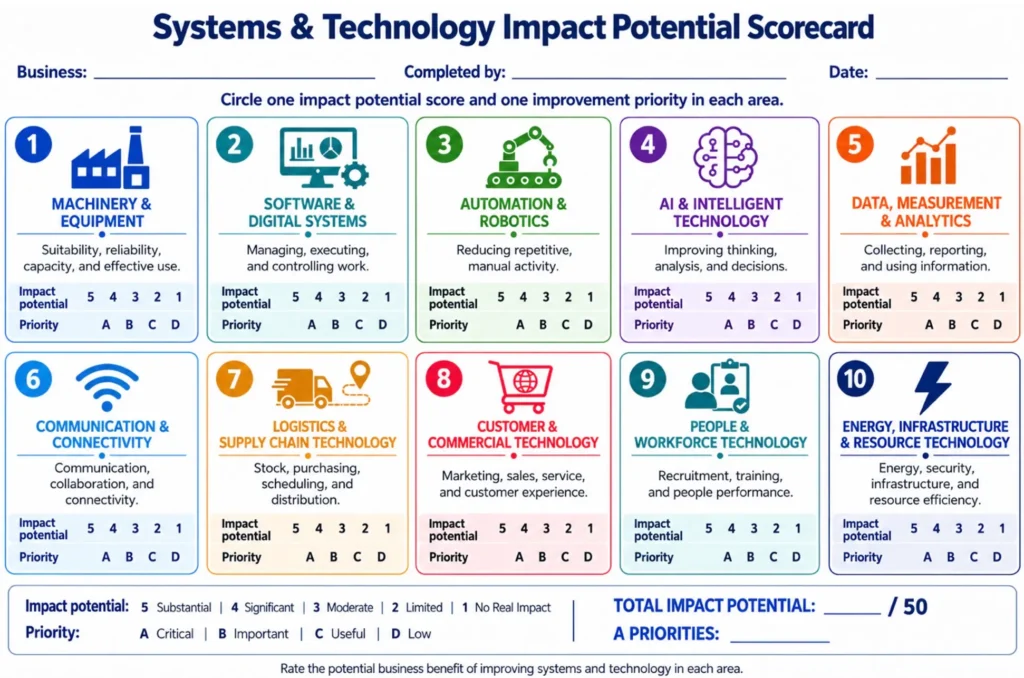
An improvement might offer substantial long-term benefits but require significant investment, preparation, or organisational change. Another might deliver a smaller benefit almost immediately, with very little disruption.
Both could be worthwhile, but the timing and sequence of implementation should be considered carefully.
When assessing opportunities, ask yourself:
- Where are we regularly losing valuable employee or management time?
- Which activities generate avoidable errors, delays, or additional costs?
- Where could better systems or technology improve customer experiences?
- Which improvements could increase our productive capacity or gross margin?
- What currently relies too heavily upon the business owner’s personal involvement?
Your answers should help establish a practical starting point.
Improving efficiency is an ongoing business need
As your business develops, its requirements will change.
Systems that worked effectively when you employed one person may well become restrictive with fifteen. Technology that once provided sufficient capability may eventually limit your productivity or management visibility.
Equally, employees often develop informal workarounds that gradually undermine otherwise effective processes.
Regularly reviewing how your company operates should therefore form part of your wider business improvement and strategic planning activities.
You do not need to overhaul the entire business to make worthwhile progress.
Choose one area with meaningful improvement potential, examine how it currently operates, establish a better systematic approach, and identify where technology could provide additional benefit.
Measure the results before moving on. Record a starting point and compare measures such as time per job, error rates, turnaround time or gross margin after the change. Check that greater speed has not come at the expense of quality or customer service.
How much more could your business achieve if the time, money, and resources currently lost through avoidable inefficiencies were put to better use?
At UK Growth Coach, we help established business owners identify these opportunities and develop practical improvement plans that strengthen performance, profitability, and long-term business value.
If you suspect your business could be achieving considerably more from its existing resources, get in touch with UK Growth Coach to explore where your greatest opportunities might exist.
Frequently asked questions about business efficiency
What are common examples of operational inefficiency?
Common examples include entering the same information into several systems, waiting for unnecessary approvals, correcting recurring mistakes and searching for information. Processes that depend on one person’s knowledge can also cause delays when that person is unavailable.
What is business systemisation?
Business systemisation means establishing and documenting how important work should be completed. It brings together process maps, procedures, checklists and training so employees can deliver consistent results without relying on memory or repeated instructions from the owner.
How can an SME identify inefficiencies in its processes?
Choose a process where delays, errors or repeated questions occur. Map the steps with the people doing the work, record who is responsible and identify where information is duplicated or work stalls. Use those findings to decide which changes are worth testing.
Should you improve processes before introducing automation?
Yes. Clarify the process and remove unnecessary steps before deciding what to automate. Otherwise, technology can repeat existing problems more quickly. Select tools that fit the improved process and make sure the team knows how to use them.
How do you measure whether an efficiency improvement has worked?
Compare performance before and after the change using relevant measures, such as time per job, rework, turnaround time or cost per transaction. Include implementation costs and check customer service and quality. Time saved only becomes a financial benefit when it reduces costs or supports valuable additional work.