

Planning in business is paramount
Without a plan for how you will exit the business or hand the reins over to someone else, it’s easy for you to get lost, mismanage resources, and put long term business continuation in jeopardy. That is why I would recommend succession planning for small business owners is done sooner rather than later!
As a business coach with years of experience, I’ve met many business owners in various stages of their careers. Some have just started the company, some are running a family-owned business, and some are ready to sell the business but don’t know where to start.
Today, I’d like to focus on planning your exit from a company and creating a succession plan to allow your business to run without you at the helm successfully.

What is succession planning for small business owners, and why do I need it?
Business succession planning involves a series of logistical and financial decisions which allow you to have the peace of mind that your company will be able to succeed once you’ve retired, or if the worst should happen.
If you are the sole owner of your business, or even if you are in partnership with another director, you must have a succession plan in place to protect yourself and ensure a smooth exit from the company and protect the company itself.
A proper business succession plan will detail what needs to be done, when, and by whom, ensuring a smooth transition to the new director. Without this in place, there is a considerable risk of your company failing to function properly once you leave.
I see so many business owners unsure of how to leave their company or reduce their hours, as they currently ‘wear too many hats’ in the business. Essentially, they shoulder the burden of too much work, meaning that if they were to leave the business for a year, say to travel or spend time with loved ones, the business would cease to function.
Having a solid succession or exit plan in place gives you the flexibility and peace of mind to decide how best to spend your time.
It may be that you want a year out, or just an extra couple of holidays a year, or maybe to wear ‘one hat’ only at work and dispense with the others.
Whatever your goal, a succession planning for small business owners is the key to enabling that to happen. It can also shed light on how current processes can be optimised within the company.
When should I make one?
It’s never too early to begin planning for your future as a business owner. Many people start a business to eventually sell and retire with their accumulated profits.
Others want to pass on their business to a key employee, or maybe even hand down the title of MD in a family-run business.
For each of these outcomes, having a robust succession plan in place will ensure that you know what needs to happen to make things work.
Generally speaking, most business owners should be looking to have a succession plan in place – regardless of how they wish to exit the business – around about five years before they plan to retire.
However, it’s important to note that unplanned exits do happen.
In these cases, businesses can experience a loss of service to their clients, and a massive drop in earnings, if the company isn’t correctly set up to work throughout a transition in leadership.
This is why I recommend having a succession plan in place as soon as possible.
How do I make one?
When succession planning for small business owners, it’s essential to consider the goals you have in mind and your projected timeline.
The first thing I ask most business owners to complete is an ‘organisational flowchart’.
This document outlines every single point of operation within a company, allowing you to have a birds-eye view of your structures and processes.
This is so important to understand, as (previously mentioned) many owners don’t realise just how much they do for the company.
Maybe it’s a few phone calls here and there to suppliers; perhaps it’s making sure accounts are up to date or ensuring health and safety documentation is kept current.
As a business owner, you can end up wearing a lot of hats, and if your business has grown gradually over time, you might not even realise it.
Succession planning for small business owners is a different challenge to that of larger companies because as the owner you’ll be fulfilling lots of different roles!
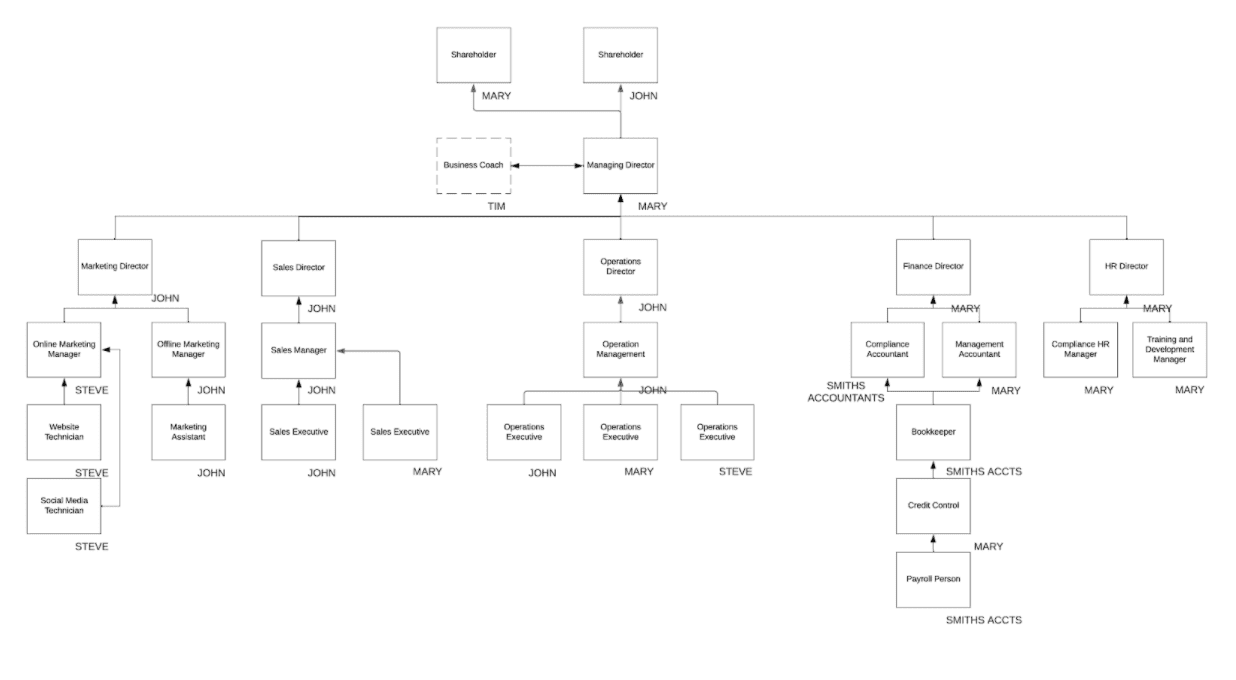
By completing an organisational chart like the one above, you create a roadmap for your eventual exit from the business, as you can see which jobs are being done by who and which ‘hats’ you need to begin taking off and passing to your employees.
However, this can be a long process, as it’s not very likely that you’ll want to just give away all responsibility to one or two employees and then leave the country for a year!
Instead, by starting this process early and having a clear understanding of who to hand over which jobs to (and when), you can begin to ease your workload and start to think about your eventual exit – safe in the knowledge that the company will operate just as efficiently without you.
In addition, this allows you as an owner to streamline your role, which has the added benefit of reducing your hours.
Once you have your organisational chart in order, you can decide which exit strategy is most applicable to you. This is the foundation point for succession planning for small business owners!
Perhaps you’ve drafted a buy-sell agreement with your business partner, and you’re now looking to sell your share of the company back to them to complete your exit, leaving them as the sole director or possibly even selling the share back to the company itself.
Maybe you run a limited company with your family members, and you’d like to pass on the role.
Having an organisational chart can ease the transitional period, as people will know and agree upon exactly what their roles and responsibilities are.
Whatever your long-term business plan is, having these processes in place will ensure that things stay on track and on time.

How we can help with your succession planning
Hopefully, by this point, you can recognise the importance of succession planning for small business owners and the power of using an organisational chart to streamline your role in the business and ensure continued success once you’ve exited.
If you are struggling to create your own succession plan or want to learn more about what I’ve discussed in this blog, please get in touch today to book a complimentary business review session with one of our business coaches or find out more about our Independence Coaching programme.