

In this blog, we are going to run through exit planning for small business owners, what an exit plan means, why you would create a business exit strategy plan and how to execute it correctly.
Exit planning and saying goodbye to your business doesn’t have to be scary or difficult!
Firstly, what is business exit planning?
A business exit plan is a strategy to change business ownership. This could either be selling the business, a management buy-out, passing on the reigns to a family member or being acquired by another company.
This is not a quick process, and lots of thought and time need to be set aside to execute it perfectly. Too often it is left until the time the business owner wants to exit, whereas in reality, to get the value out of your business, it takes much longer to prepare. There is more information and real-life business testimonials on how UK Growth Coach can help small businesses exit plan elsewhere on the website.
What are your motives for exiting your business?
There are many different reasons why a business owner might want to exit their business.
Here are some typical examples of why a business owner may want to sell their business:
- Retirement
- Move on to something else / start-up another business
- Reduce hours or responsibility
- Extract the business value for personal reasons.

What are your goals?
Before a business owner decides to plan their exit, it’s good to know why they’re exit planning. Is the motive strategic and planned with care, or due to a crisis such as bad health which needs urgent resolution?
Here are a few example goals:
- Enable succession, for example, MBO (management buyout) or family succession
- Sell to an investor
- Attract an acquisition
- Create asset wealth (in one go)
- Enable gradual wealth (passive income / gradual buyout).
As you can see, motives and goals are important, as they can influence the best path forward.
Once a business owner has decided on his or her motive and goal, it’s time to start planning and developing an exit strategy.
Exit planning for business owners
As with all plans, there needs to be a set of clear goals, timelines, involved parties, and assigned roles and responsibilities.
The clearer and better defined your exit plan, the more likely it is to succeed.
At UK Growth Coach, we have identified 10 Valuation Factors.
The 10 valuation factors:
- Proven track record
- Future confidence
- Investment required
- Secured future turnover
- Owner independence
- Linchpin reliance
- Brand and reputation
- Uniqueness of offering
- Level of systemisation
- Personnel
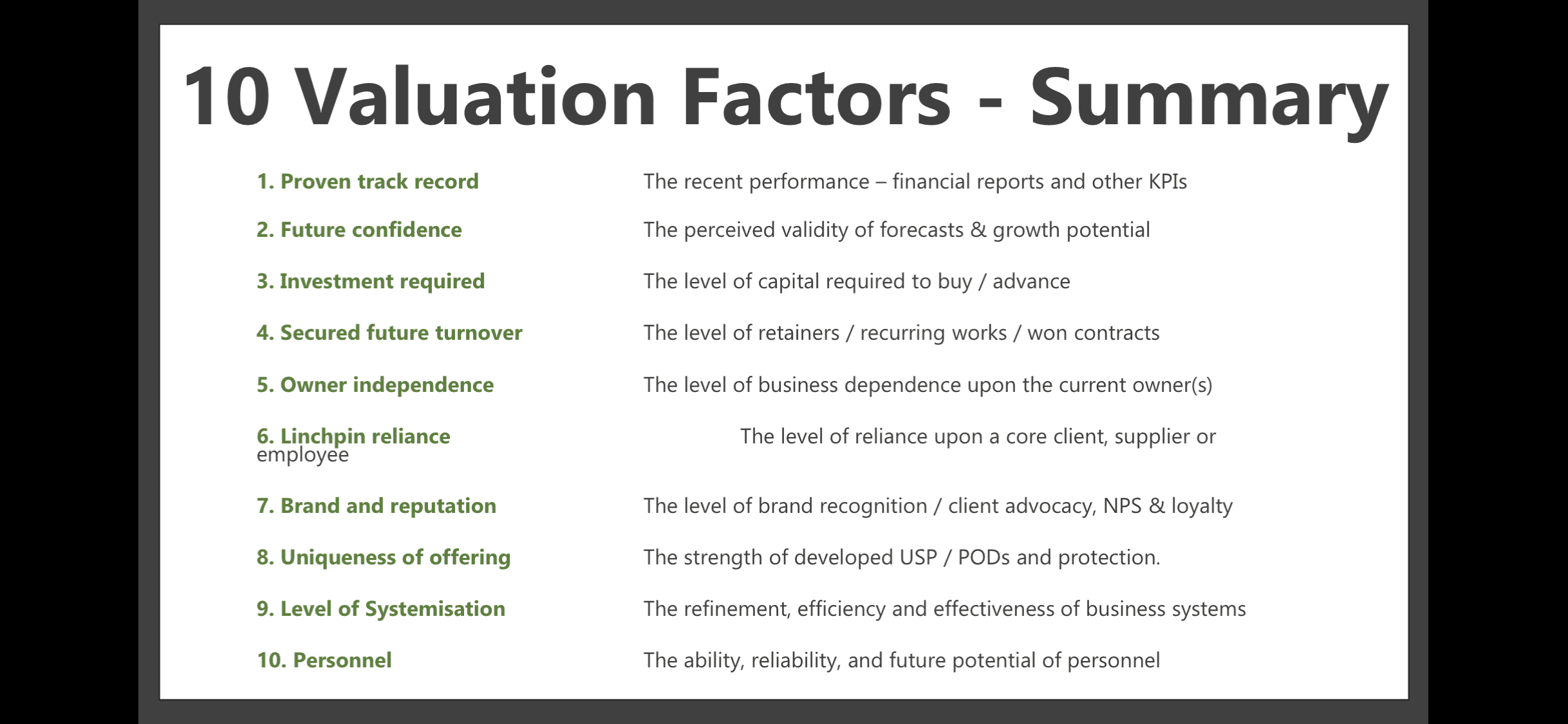
Do you have documentation to enable someone to make an assessment of your business across these 10 areas?
And if you do, what picture does it paint of your business?
- One of future prosperity
- One that needs further work
- A business reliant on you for success
- Or something else?
It is a really useful exercise, even if it’s just rough at this stage, to look at these valuation factors and determine whether they are where you need them to be. If not, what is your action plan to get them to the level you want? This is then the bedrock of your exit strategy and action plan.
Exit planning - UK Growth Coach
We here at UK Growth Coach can help you set up and keep on track with your exit plan.
Book a complimentary 90-minute Business Review session to learn more about increasing the value of your business for sale.