

Is your business building wealth, or just keeping you busy? What our Progress Mountain shows business owners
Business owners find themselves asking — ‘is my business building wealth for me?’ Sometimes it is, but often it is not, and often far from the levels your efforts deserve!
A lot of business owners assume that if turnover is decent and money is being made, the wealth part must be taking care of itself.
You can work hard for years, build a solid reputation, employ people, carry a lot of responsibility and still find that the business is not really building wealth for you in the way you expected. Instead, it may be producing you an income. It may be funding a lifestyle. But wealth is something different. Wealth is about what the business creates for you over time and into the future, not just what it pays you for your effort this month.
That distinction matters even more when you look at how wealth is actually built in the UK. ONS says property wealth and private pension wealth make up the largest components of household wealth in Great Britain, not short-term income alone.
That is why this question matters: is your business actually building wealth for you, or are you still operating (and earning) as an employee within your business?
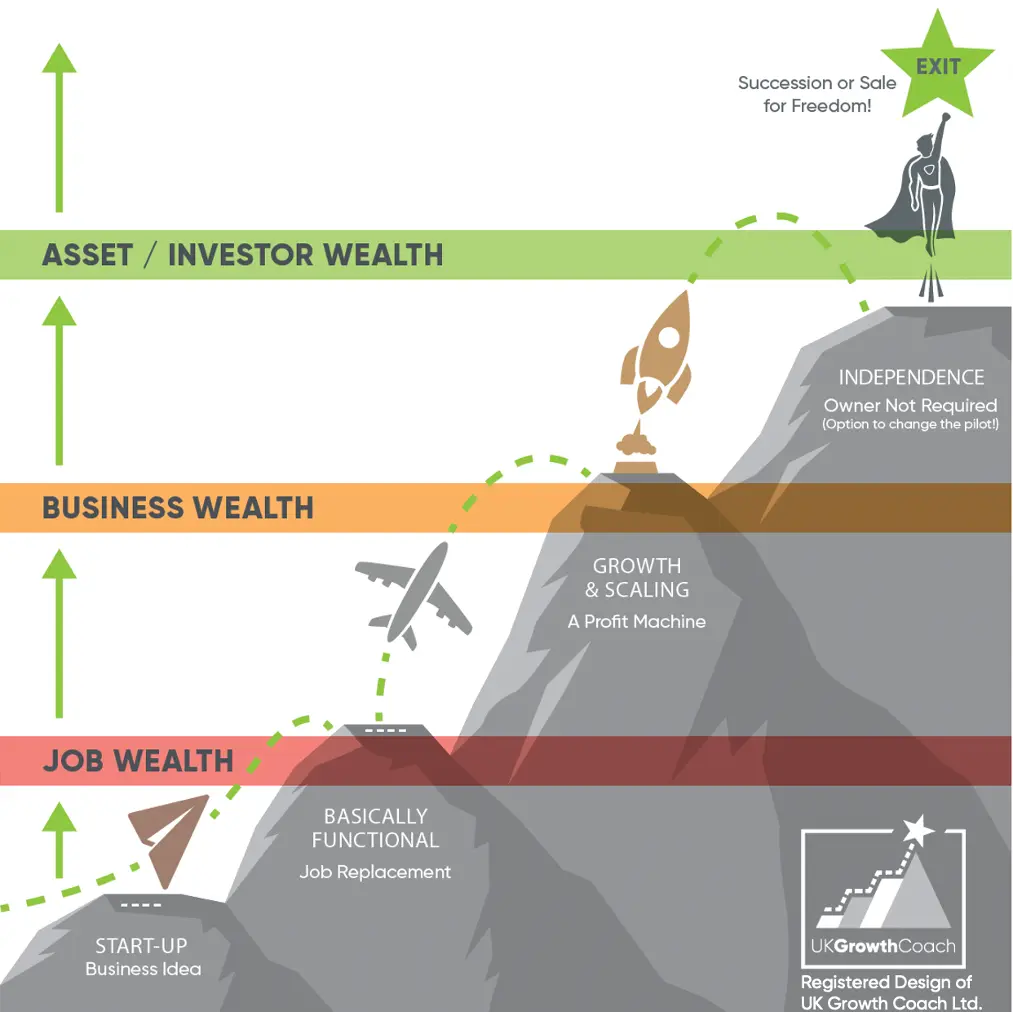
This is where UK Growth Coach’s Progress Mountain model is useful. On our site, we describe the Progress Mountain as our unique business journey model, with different levels of progression and different challenges at each stage.
A quick summary
Many business owners confuse income with wealth. The Progress Mountain helps show the difference. It maps a journey from job wealth, to business wealth, to creating an asset for yourself, and then to creating an asset for others. The key point is that there is another stage beyond simply owning a successful business. Wealth is usually built through assets, planning and value that lasts beyond your own day-to-day effort, not just through staying busy.
Why this question matters more than most owners realise
A business can look successful from the outside and still fall short as a wealth-building vehicle.
This typically happens when the owner is at the centre of business operations. The business depends on their effort, their decisions, their client relationships or their constant oversight to function, to perform and to grow.
In those cases, the business may generate money, but it does not yet create wealth, freedom or long-term value for the owner. That is one reason exit planning and succession matter earlier than many owners think.
The British Business Bank says developing an effective exit strategy requires planning to achieve the highest possible valuation and identify the right buyer, while FSB describes succession planning as the process that decides who will take over the business when the owner retires or the unexpected happens.
In other words, you are not only asking whether the business earns well; you are asking whether it is becoming something bigger than your own labour.
Every owner has a different vision for their business, and exiting may not be on your radar or even part of your long-term plan. The point though is that at some point, you are going to want to have the ability to choose what you do in your business and when you do it, not to mention the financial resources to do the things you want to do for yourself and your family.
By putting the right things in place and proper planning, it is possible for you to get your business to this stage.
The first stage: job wealth
This is where a lot of business owners spend longer than they expected.
At the job wealth stage, the business gives you an income. It may even give you a slightly better income than employment did. You have more control and more autonomy than you had in a traditional job. On the surface, that can feel like success.
The issue is that the business still relies heavily on you. If you stop, it slows… or indeed stops too! If you disappear for too long, problems pile up. The income is real, but the wealth is closely tied to your effort, and short-lived.
That does not make this a bad stage. It is a necessary stage. Many businesses operate at this level, and because you see your peers at this stage, it can be easy to assume that ‘this is it’, whereas in reality this is not the pinnacle of business ownership.
For example, ONS data shows that self-employed people are less likely than employees to contribute to private pensions, and the data also shows a large share of self-employed people have no private pension wealth at all, particularly in the 35 to 54 age group. That means many owners may be generating income to cover things for today but may not be building wealth for the future.
The second stage: business wealth
This is where things start to shift and get exciting for business owners!
At the business wealth stage, the business becomes more than a vehicle for personal earnings. It begins to leverage its processes, systems, people, and competitive advantage in order to generate wealth for you.
Systems improve. Delegation gets better. Team capability rises. The owner is still important, but not every outcome depends on them directly.
This stage often brings a different feeling. The business starts to feel more robust and less fragile. Profit becomes more deliberate, decision-making improves, and the owner gets some headspace back.
This is also where many business owners see the difference between being self-employed and genuinely owning a business.
The third stage: an asset for yourself
This is where the conversation becomes more strategic and you’ve many more choices available to you in the present and for the future.
When your business becomes an asset for you there is the option of having it generate a passive income for you, whereby you don’t have to be working in the business at all for you to be earning and wealth generation.
Having a business as a passive source of wealth generation may not be your preferred route, instead you may prefer to have a specific role or responsibility in the business with everything else left to other people. You could be the Sales Director of the business, but the operations, HR, people management, marketing etc are all for others to do. In a scenario like this, you’ve chosen your role and earn a ‘salary’ for it but the business is still generating wealth for you as the owner. A business owner, leveraging the processes, systems and people you’ve built, but no longer having to do everything.
Wealth is not only about what you extract from the business but also about what the business enables.
ONS says median household wealth in Great Britain was £293,700 in the period from April 2020 to March 2022, with property wealth and private pension wealth making up most of it. This is a useful reminder that wealth is usually built through asset accumulation and planning, not simply through earning well in a busy year.
At this stage, you are starting to use the business as a tool for wider personal wealth creation, rather than simply relying on it to provide your monthly reward.
The fourth stage: an asset for others
This is the stage many owners have not thought about properly.
A business can become an asset for others. In other words, it can become valuable not just because of what it gives you, but because of what it would represent to someone else. That could be a future buyer, a successor, a management team, a family member or an employee ownership structure.
This is an important shift because it asks a harder question: does the business have value beyond you?
If the answer is no, then there is still work to do.
Why owners get stuck before the top
Many business owners get stuck because their business keeps demanding their energy in the present, which leaves very little room to build for the next stage. The urgent wins over the important.
Most business owners have not been trained in how to run, grow, scale or exit a business, which creates a significant skills and confidence gap when it comes to moving up the Progress Mountain. Your trade and professional skills may mean you can create a job for yourself, but will it enable you to build a business, to create an asset for yourself or others?
What this means is that the business stays owner-led for longer than they should.
Over time, that creates a ceiling. The wealth journey slows because the structure underneath it has not evolved. That is exactly why UK Growth Coach maps business growth in stages rather than treating ownership as one flat destination. On our site, we make the point that while each stage yields higher results, each step brings its own symptoms and challenges.
How UK Growth Coach helps owners move up the mountain
At UK Growth Coach, we use The Progress Mountain to help owners see where they are, and where they really want to get to.
We also use our Coaching Star model to identify what is holding the business back across key areas of performance. Sometimes the barrier to wealth is profit, sometimes it is leadership, and other times it is people management, or a lack of planning rhythm.
To help you understand what all of this means for your own business, we offer business owners a complimentary 90-minute Business Review. During this session we’ll review your current situation, your ambitions, map where you are at on your business journey and highlight areas that will help you make the progress you want. It is entirely free of charge, designed for those with a turnover of over £100k and we promise not to mention our services unless you ask us about them.
Together we can see how you can progress towards greater business wealth creation.
📞 01444 440500
📩 connect@growthcoach.co.uk

FAQs
What is The Progress Mountain?
The Progress Mountain is our model for understanding the stages of business ownership and wealth creation. It speaks to different levels of progression, and we offer distinct services designed to match those stages.
What is job wealth?
Job wealth is where the business creates income for the owner, but still depends entirely on their effort and involvement. It can feel successful, but it is not yet the highest stage of business ownership.
What is business wealth?
Business wealth is where the business itself starts creating stronger value through better structure, stronger profit, clearer systems and less day-to-day dependence on the owner. By leveraging the processes, people and competitive advantage of the company, you are able to generate wealth beyond a salary.
What does “asset for yourself” mean?
It means the business is helping build your wider personal wealth, not just paying you an income.
What does “asset for others” mean?
It means the business has real value beyond you. It may be attractive to a buyer, useful to a successor, or capable of operating in a way that creates value for employees or other owners in the future.
Why do business owners get stuck at job wealth?
Usually because the business remains too dependent on them. They stay central to decisions, delivery and relationships, which limits the business’s ability to become more valuable in its own right.
Is income from my business the same as wealth?
Not necessarily. Income is what the business pays you now. Wealth is about the value it builds over time and the options it creates for your future.
Why is this especially relevant for owner-managers?
Because self-employed and owner-led people do not always build pension wealth in the same way employees do.
How does this connect to the Independence Stage?
The Independence Stage is about building a business that does not depend on you for everything. That gives you more freedom of choice and helps move the business further up the mountain.
What is the best first step if I want my business to build more wealth?
Start by understanding what stage you are currently at, then identify what is stopping progress. That is usually where a proper coaching conversation becomes most useful.